

A working migration-assurance model from source extraction to target reconciliation
While building SafeBridge, I did not begin by looking for five attractive project phases. I was trying to solve a more practical problem: how can three very different parts of an SAP migration work as one controlled system?
ECC knows the real source data. SAP BTP can hold the migration-object definition, analyze instances, apply controlled rules and preserve evidence. S/4HANA owns the real target contract, configuration and posting behavior. None of the three parts contains the full truth by itself.
Five Gates grew from investigating how to connect these three environments without confusing an assumption with verified evidence. The gates form the SafeBridge migration-assurance path. Each gate answers one question, records one verdict and prevents an unresolved migration-object instance from silently moving forward.
ECC supplies source truth. S/4HANA supplies target truth. SafeBridge on BTP connects them with governed evidence.
What “Five Gates” is – and what it is not
“Five Gates” is the control backbone of SafeBridge. It follows one migration-object instance from an ECC source snapshot, through BTP validation, into the S/4HANA Migration Cockpit, and back to BTP for independent reconciliation.
It is not a generic AI project-management method, and it is not the entire data-migration product. SafeBridge still needs ABAP extractors, secure transfer, a migration-object catalogue, mappings, a rule engine, instance storage, a worklist, SAP adapters, evidence history and approval controls. The gates organize those functions around clear proof points.
The Excel workbook is a review artifact, not the runtime. It can be imported from or exported to the Migration Object catalogue, but the versioned CAP data model on BTP remains the operational source of truth.
How the three environments connect
The simplest architecture is shown below. No gate runs in ECC. Gates 1, 2, 3 and 5 run in SafeBridge on SAP BTP. S/4HANA executes Migration Cockpit Simulate at Gate 4 and remains responsible for the supported posting path.
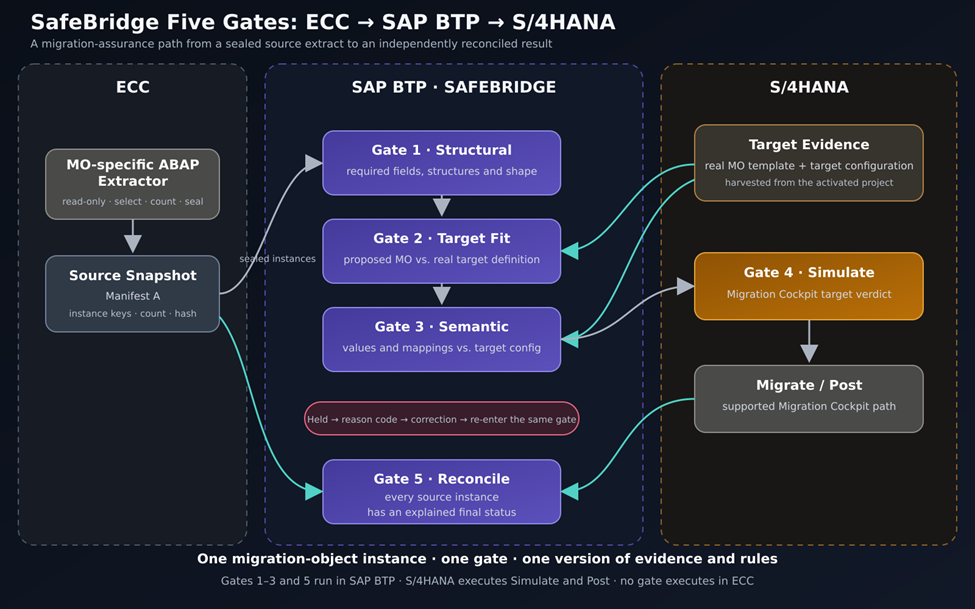
“Five Gates” connects the systems through versioned evidence. A failed instance is held with a reason code, corrected and re-entered at the gate that stopped it.
The operational definition of the “Five Gates”
The words Define, Ground, Build, Prove and Reconcile work well in a presentation. They are not the technical definitions. The SafeBridge implementation uses the following checks:
| Presentation label | Operational SafeBridge definition |
| Gate 1 – Define | Structural check – required fields, structures and shape |
| Gate 2 – Ground | Target-fit check – proposed Migration Object versus the real target definition |
| Gate 3 – Build | Semantic check – values and mappings against verified target configuration |
| Gate 4 – Prove | Migration Cockpit Simulate – the S/4HANA target system’s verdict |
| Gate 5 – Reconcile | Instance-level reconciliation – every source instance has an explained final status |
Gate 3 – Build does not mean software development. It means building migration-ready instances within the verified target contract and semantic rules.
Gate 1 to Gate 5 in practice
G1 DEFINE – STRUCTURAL CHECK
Does the source instance fit the proposed Migration Object structure?
The ECC extractor produces an unchanged source snapshot and Manifest A: migration-object instance keys, counts, extractor version and hash. Gate 1 runs on BTP and compares those instances with the proposed Migration Object definition.
It checks expected structures, keys, required fields, formats and relationships. Passing Gate 1 means structurally coherent. It does not mean that the definition matches the client target or that the values are acceptable in S/4HANA.
G2 GROUND – TARGET-FIT CHECK
Does the proposed definition match the real activated S/4HANA Migration Cockpit project?
SafeBridge harvests the real target definition from the activated Migration Cockpit project and compares it with the proposal used at Gate 1. This can expose hidden fields, extensions, different mandatory flags, naming differences and assumptions that the client system does not support.
SAP Help supported an object-level reference, but all 64 field rows remained REFERENCE_UNAVAILABLE until real target evidence could define them. Gate 2 prevents a useful proposal from being mislabeled as a verified implementation contract.
G3 BUILD – SEMANTIC CHECK
Do the values and mappings make sense for the verified target configuration?
A structurally valid instance can still fail because a controlling area, company code, profit center, category, hierarchy node or value-map target is missing or invalid. Gate 3 checks those target-dependent meanings on BTP using harvested and versioned configuration evidence.
A failed instance is not deleted. It is held with a typed reason, owner and field or row locator. After the data, mapping or configuration is corrected, only that subset re-enters Gate 3.
G4 PROVE – MIGRATION COCKPIT SIMULATE
What does the S/4HANA target system say about the prepared instances?
BTP validation cannot reproduce every SAP posting rule. Gate 4 therefore uses the Migration Cockpit Simulate result as the authoritative target verdict. S/4HANA performs the simulation; SafeBridge captures the returned evidence and connects each error to the affected migration-object instance.
A successful Simulate result is evidence for the load decision. It is not itself permission to migrate.
G5 RECONCILE – INSTANCE-LEVEL ACCOUNTING
Can every source instance be connected to an explained final status?
After the supported Migration Cockpit load, Gate 5 runs independently on BTP. It compares Manifest A, the ECC source denominator; Manifest B, the approved selection and exclusions; and Manifest C, the migration-instance results from the target.
The important unit is the Migration Object instance, not a spreadsheet row. One Business Partner may contain several address, role and bank rows, but the instance passes or fails as a whole. A reason locator can still point to the exact field or child row that needs correction.
Before load: 842 extracted = 263 ready to post + 47 held with reasons + 532 excluded by approved scope.
After load, Gate 5 requires: source = posted + held + excluded + unexplained. The unexplained count must be zero.
The 842-record example is synthetic and illustrates the readiness balance, not a completed client migration result.
What completes SafeBridge around the gates
Five Gates supplies the control logic, but a working SafeBridge implementation needs supporting components around it:
- ECC extraction creates a sealed, versioned source snapshot for each Migration Object.
- Migration Object catalogue stores proposed and harvested definitions, structures, fields, mappings, rules and dependencies as versioned CAP data.
- Migration Worklist presents reason-coded held instances and controlled correction decisions.
- SAP boundary integration harvests target evidence and captures Migration Cockpit Simulate and migration results.
- Control Tower preserves evidence, reconciliation and the human approvals attached to a run.
Where AI agents belong
AI agents can propose a field mapping, classify transformation prose, explain a cluster of failures or draft an extractor for a deep or custom object. Those tasks can remove a great deal of repetitive analysis.
They do not decide whether an instance passes a gate. Deterministic rules produce the BTP verdicts, S/4HANA supplies the target verdict, and the human owner authorizes consequential actions.
AI proposes and explains. Deterministic checks evaluate. SAP supplies target evidence. Humans approve.
The human approvals remain separate
The five gates answer evidence questions. Human approvals authorize business consequences. SafeBridge keeps these responsibilities separate:
- A1 – scope and mappings: accept the selected population and verified mappings.
- A2 – authorize load: review Gate 4 evidence and decide whether migration may proceed.
- A3 – final business sign-off: accept the reconciled outcome after Gate 5.
Why this model matters
“Five Gates” does not add five meetings. It prevents one kind of evidence from being mistaken for another. Structural validity is not target fit. Target fit is not semantic validity. Local validation is not the target-system verdict. A successful load is not proof that every source instance was accounted for.
The model also makes correction practical. A held instance remains visible with its cause and owner. It returns to the gate that stopped it instead of restarting the entire migration. Findings, mappings, reason codes and test evidence can then be reused for the next Migration Object.
Where I have landed
“Five Gates” came from trying to connect ECC, SAP BTP and S/4HANA without pretending that any one of them contains the complete migration truth. ECC tells SafeBridge what exists. BTP evaluates and preserves evidence. S/4HANA tells SafeBridge what the real target accepts. Reconciliation brings the result back to the original source population.
This is a working architecture and implementation strategy being developed through SafeBridge. It is not yet a claim of a completed client pilot or a replacement for every SAP migration function. Its value is narrower and, I think, more useful: it gives the migration a controlled path from source evidence to an explained target result.
One Migration Object. One instance. One gate. One version of evidence and rules.
For SAP developers and migration consultants: where does your project lose the connection most often – source extraction, target definition, semantic validation, Simulate, or reconciliation?